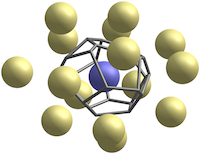
The following filter files were generated using VoroTypes, which deterministically enumerates all combinatorial types of Voronoi cells that can arise from infinitesimal perturbations of a crystal structure. Filters are listed below for 1,088 of 1,300 stable materials from the Materials Project database, spanning all seven crystal systems and 91 space groups. Each filter can be used directly with VoroTop or with the VoroTop modifier in OVITO.
For every structure, up to three nested filter variants are provided: primary ⊆ default ⊆ all. The primary filter contains only the primary resolutions of each degenerate vertex — the smallest and computationally easiest filter, appropriate for theoretical T → 0 analysis. The default filter additionally contains the fully-resolved secondary types that occur with small but positive frequency at any T > 0 — recommended for finite-temperature MD trajectories. The all filter further includes partially-resolved types in which a degenerate vertex may remain unresolved — recommended when the perturbation is too small to break the degeneracy in any numerical sense. In each column, the number of Weinberg types is shown as a link to the corresponding filter file; blank entries indicate that the structure did not complete within the 300 s time budget used for this library.
Filters for two-dimensional lattices (square, Lieb, kagome, and others) are listed below the table. The CIF file used to generate each filter is also available for download. For additional pre-built filters for common structure types (BCC, FCC, HCP, etc.), see the Download page. To generate filters for structures not listed here, use VoroTypes or VoroTop's -mf option.
| Formula | MP ID | Space Group | Sites | CIF | Primary | Default | All |
|---|
Two-Dimensional Lattices
The following filters were generated using the -2 option of VoroTypes (version 1.2). In two dimensions, the topology of a Voronoi cell is recorded by its p-vector: the number of edges of the cell, followed by the numbers of edges of its neighbors in cyclic order (see Lazar et al., 2024). A degenerate Voronoi vertex, where more than three cells meet, resolves under perturbation into one of the triangulations of the polygon formed by the particles around it; the filters list every p-vector obtained by combining these resolutions. In two dimensions every resolution is primary, so only default and all variants are provided; the all filter adds partially resolved types. Use these filters with VoroTop's -2 option:
VoroTop system.dump -2 -f square.filter -l| Lattice | Sites | Degenerate vertices | Default | All | Notes |
|---|---|---|---|---|---|
| Triangular | 1 | none | 1 | 1 | Stable: every cell is a hexagon surrounded by hexagons. |
| Square | 1 | 4 cells meet | 1,261 | 3,959 | Also applies to any rectangular lattice. |
| Lieb | 3 | 4 cells meet | 55 | 88 | Two types: corner sites (type 1) and edge sites (type 2). |
| Kagome | 3 | 6 cells meet | 176,128 | 233,662 | Large files (4.3 MB and 5.7 MB). |
| Honeycomb | 2 | 6 cells meet | — | — | Not enumerated; see below. |
Honeycomb (graphene) lattice. The Voronoi cell of a honeycomb site is a triangle, each of whose corners is shared by six cells. Under perturbation the cell can have between 3 and 12 edges, and its p-vector depends on how 12 such six-fold vertices resolve, giving 1412, or about 5.7×10¹³, combinations. The resulting family is far larger than that of the kagome lattice, whose p-vectors depend on only 10 six-fold vertices, and too large for a practical filter. For honeycomb systems, a stochastic filter can be generated with VoroTop:
VoroTop honeycomb.dump -2 -mf 1000000 0.001Other lattices. Filters for other two-dimensional crystals can be generated with VoroTypes from a short text file listing the two lattice vectors and the fractional coordinates of each atom (see the example for the Lieb lattice):
python enumerate_cells.py -2 mylattice.txt