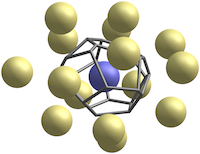
The VoroTop modifier in OVITO requires the choice of a filter, which specifies possible structure types and associated Voronoi cell topologies. The modifier calculates the Voronoi cell topology of each particle, uses the provided filter to determine the structure type, and stores the results in the Structure Type particle property.
Each filter is stored in a text-based format. Structure types are specified at the beginning of the file. Subsequent lines specify topological types, as described by Weinberg vectors, and their associated structure types. Files may be saved in compressed (gz) form, which can be processed by OVITO.
Different crystal structures require different filters. A larger collection of filters for 779 materials from the Materials Project is available in the Filter Library. Users can also generate custom filters from crystal structures using the -mf option in VoroTop, or use VoroTypes to deterministically enumerate all possible Voronoi cell topologies for a given crystal structure. See the documentation for details.
| Filter name | Structure | Notes | |
|---|---|---|---|
| BCC | 1 | BCC | Identifies particles with body-centered cubic (BCC) local structure; ignores all other structure types. |
| FCC | 1 | FCC | Identifies particles with face-centered cubic (FCC) local structure; ignores all other structure types. |
| HCP | 1 | HCP | Identifies particles with hexagonal close-packed (HCP) local structure; ignores all other structure types. |
| ICOS | 1 | ICOS | Identifies particles with icosahedral local structure; ignores all other structure types. |
| FCC-HCP | 1 2 | FCC HCP (non-FCC) |
Designed for studying FCC systems with HCP-type defects (e.g., dislocation, twin planes, and stacking faults). |
| HCP-FCC | 1 2 | HCP FCC (non-HCP) |
Designed for studying HCP systems with FCC-type defects (e.g., dislocation, twin planes, and stacking faults). |
| FCC-both-HCP | 1 2 3 | FCC FCC/HCP HCP |
Designed to study systems with both FCC and HCP local structure. |
| FCC-BCC-ICOS-HCP | 1 2 3 4 5 | FCC BCC ICOS FCC/HCP HCP |
Designed to study general systems which may contain different structures. |
| B123 | 1 2 3 4 | BCC B1 B2 B3 |
Identifies three ∑5 symmetric tilt boundaries in a BCC bicrystal; we (arbitrarily) call them B1, B2, and B3. |
- Lazar, E.A. "VoroTop: Voronoi Cell Topology Visualization and Analysis Toolkit", arXiv, Model. Simul. Mater. Sci. Eng 26:1, 2017.
- Lazar, E.A., Han, J., and Srolovitz, D.J. "A Topological Framework for Local Structure Analysis in Condensed Matter", arXiv, Proc. Natl. Acad. Sci. 112:E5769 (2015).
A complete list of publications is available on the Documentation page.